

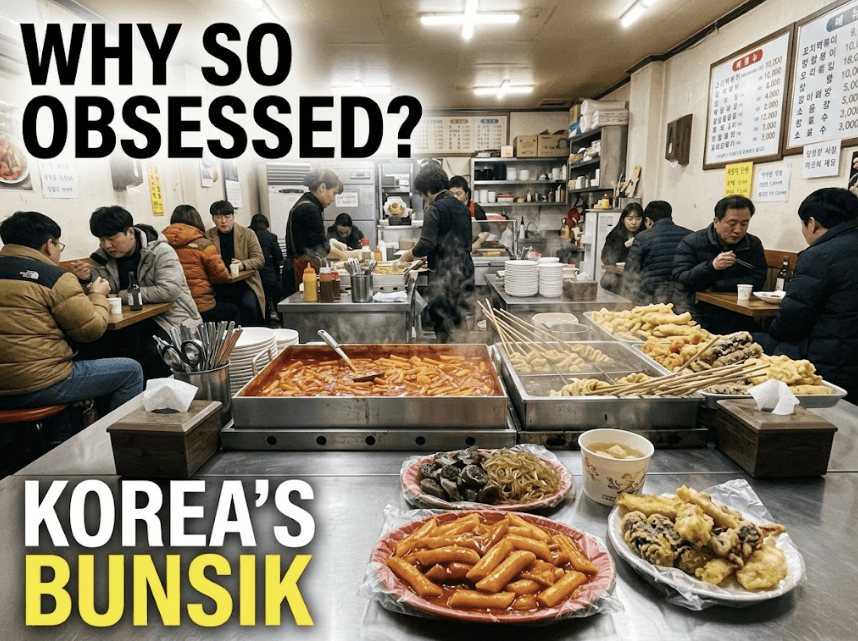
Do you know what most of my foreign friends want to eat first when they visit Korea? You might guess a fancy Korean BBQ joint or a high-end traditional restaurant, but surprisingly, the number one request is almost always a humble, neighborhood Bunsik (street food) spot.
Just the other day, a friend visiting Seoul asked me out of the blue, “Whenever I watch a Netflix Korean show, they always go eat that spicy red stuff after school. What exactly is it? I need to try it!”
So, I canceled our reservations at a nice restaurant and took them straight to a local, hole-in-the-wall Bunsik shop—the kind that holds the real soul of Korean food culture. Today, rather than just listing popular restaurants, I want to share a raw, honest review of what Korean Bunsik really is, why it exists, and why K-drama protagonists are so obsessed with it.
The K-Content Phenomenon: Why Are They Always Eating Tteokbokki?

If you pay close attention to Korean movies and dramas, a Bunsik shop is never just a place to eat; it’s a meaningful backdrop. Take the recent global action-fantasy hit K-Pop: Demon Hunters. After a massive, tension-filled battle, where do the heroes gather to heal their exhausted bodies and minds? A familiar, cozy neighborhood Bunsik shop.
You’ll see it everywhere. In the hit series Moving, a specific tonkatsu and tteokbokki spot serves as a bittersweet, nostalgic location for the main characters. In almost every teen drama, it’s the default setting for after-school romance. Even in K-zombie thrillers, the ultimate comfort food that survivors crave the most in their shelters is sweet and spicy tteokbokki.
Naturally, international viewers can’t help but wonder: What exactly does that red food taste like, and why do Koreans treat it like a sanctuary for their souls?
From Rice to Flour: The Unexpected History of Bunsik

When I briefly explained the history of this food to my friend over our meal, they were genuinely surprised. While it’s a trendy street food today, its origins are actually tied to strict survival.
The word Bunsik (분식) literally translates to “foods made from flour.” In the 1960s and 70s, during the post-war recovery period, Korea was facing a severe rice shortage. To combat this, the government launched a massive campaign encouraging citizens to consume wheat flour, which was being provided as foreign aid. Schools would even inspect students’ lunchboxes to ensure they had mixed enough barley or flour-based foods with their rice.
To feed hungry students cheaply, small mom-and-pop shops in front of schools started making rice cakes out of cheap wheat flour, tossing them in gochujang (red chili paste). That was the birth of the “school-front Tteokbokki” we know today. What started as a desperate survival diet during times of poverty has evolved into an absolute soul food that modern Koreans need on a regular basis. It’s a delicious irony of history.
The Ultimate Combo That Never Fails: “Tteok-Twi-Sun”

If you stand in front of a Bunsik menu for the first time, the sheer number of options can cause a system overload. When in doubt, just remember the golden rule of Korean street food: the “Tteok-Twi-Sun” combo (Tteokbokki, Twigim, and Sundae).
I’ll admit, I was a little worried at first. For a foreigner, Sundae (Korean blood sausage, stuffed with glass noodles and pork blood) has a visual barrier to entry. Sure enough, my friend picked up a fork, stared at the dark slices, and hesitated.
Instead of the usual salt dip, I dunked a piece of Sundae deep into the thick, sweet, and spicy tteokbokki sauce and handed it over. They chewed it skeptically for a second before their eyes lit up. “You could dip an old shoe in this spicy-sweet magic sauce and it would taste amazing!” they joked. Watching them dunk crispy fried seaweed rolls (Gimmari) and squid tempura into the sauce proved that the “Tteok-Twi-Sun” formula transcends all nationalities.
Add a roll of sesame-oil-brushed vegetable Gimbap and a cup of steaming fish cake broth, and you’ve got a meal that rivals any fine-dining course.
When Do Koreans Actually Eat Bunsik?
While downing a cooling yogurt drink to fight the spice, my friend asked why Koreans eat this stuff all the time. I broke it down into three main situations:

- After a brutally stressful workday: When Koreans are stressed out from office politics or heavy workloads, the number one late-night delivery food is spicy tteokbokki. Sweating out your anger with pure capsaicin is a time-honored modern stress relief method.
- When time and money are tight: It’s one of the few meals left where you can get completely full for under $10. A packed roll of Gimbap and a bowl of ramen is a lifesaver on a busy lunch break.
- For the pure, fuzzy nostalgia: Almost every Korean has a childhood memory of buying tteokbokki in a small paper cup for 50 cents outside their elementary school. Even as adults, smelling that sweet, bubbling red sauce instantly brings a sense of deep comfort and nostalgia.
5. Real Review & Local Tips: The Good and The Gritty
Skipping the flashy delivery franchise apps and opting for an old-school market Bunsik shop was the right call. Eating off of green, marble-patterned plastic plates wrapped in thin plastic bags, surrounded by the chaotic chatter of local students—the vibe itself was a perfect cultural experience.
However, keeping it real, there are a couple of things you should know before you go:
- The Hygiene Reality Check: Traditional market stalls aren’t going to have hotel-level sanitation. If you are highly sensitive to hygiene, you might want to try a modern Bunsik franchise (like Yeopdduk or Sinjeon) or a department store food court instead.
- Beware the Spice: Never forget to adjust the spice level. What is considered “mild” or “normal” for a Korean can feel like a biological weapon to a foreigner. Always remember to say, “Not spicy, please” (An-maep-ge hae-ju-se-yo) to protect your stomach.
Final Thoughts
By the end of the meal, my friend didn’t put their fork down until the tteokbokki plate was completely scraped clean.
From Korea’s tough modern history to the fierce daily lives of its people today, all of our joys and sorrows are simmering in that iron tteokbokki pan. Next time, we plan to step completely off the Netflix screen and try the savory “Oil Tteokbokki” at Tongin Market or the deep, seafood-broth “Mul-tteok” in Busan.
If you’re planning a trip to Korea, by all means, enjoy the famous BBQ. But make sure you push open the door of a slightly worn-down, neighborhood Bunsik shop. It will be your fastest, most intense, and most authentic taste of the real Korea.
💬 Frequently Asked Questions (FAQ)
Q1. Do I need cash, or can I use a credit card?
A: For established brick-and-mortar shops and modern franchises, your foreign credit card or travel card (like Namane or WOWPASS) will work perfectly fine. However, if you are eating at an old-school traditional market stall or a tented street cart (Pojangmacha), cash is still king. Most locals use bank transfers at these carts, which tourists can’t do, so always keep a crisp 10,000 KRW bill in your pocket just in case!
Q2. I’m vegetarian. Is it safe for me to eat Tteokbokki?
A: This is a common trap! While Tteokbokki looks like it’s just rice cakes and red pepper paste, the hidden base of the sauce is almost always anchovy or seafood broth, and it usually contains fish cakes (Odeng). If you are strictly vegetarian or vegan, your safest bets at a Bunsik shop are ordering Vegetable Gimbap (you can request “No ham, no egg, please” / “Ham gyelan ppae-ju-se-yo”) and plain vegetable Twigim (like fried sweet potatoes or squash).
Q3. How do I order if I don’t speak any Korean?
A: Don’t panic! You don’t need to be fluent to get a great meal. Most street-side Bunsik spots operate on a universal “point and smile” system. Just point at the bubbling tray of food you want and hold up your fingers for the quantity. For indoor restaurants, you will likely find self-order touch-screen kiosks right by the door, and the vast majority of them have a dedicated English language button at the top right corner of the screen.
Q4. Is Tteokbokki really that spicy? I have a low spice tolerance.
A: It can be a “creeping” heat. The deep red sauce is often a mix of sweet and spicy, but the spice builds up as you eat. If you are a beginner, avoid massive delivery franchises like Yeopdduk (which are famous for punishing levels of spice) and stick to local school-front stalls, which tend to make their sauce much sweeter. Pro tip: Always order Odeng (fish cake soup); the warm, savory broth is perfect for washing away the burn!