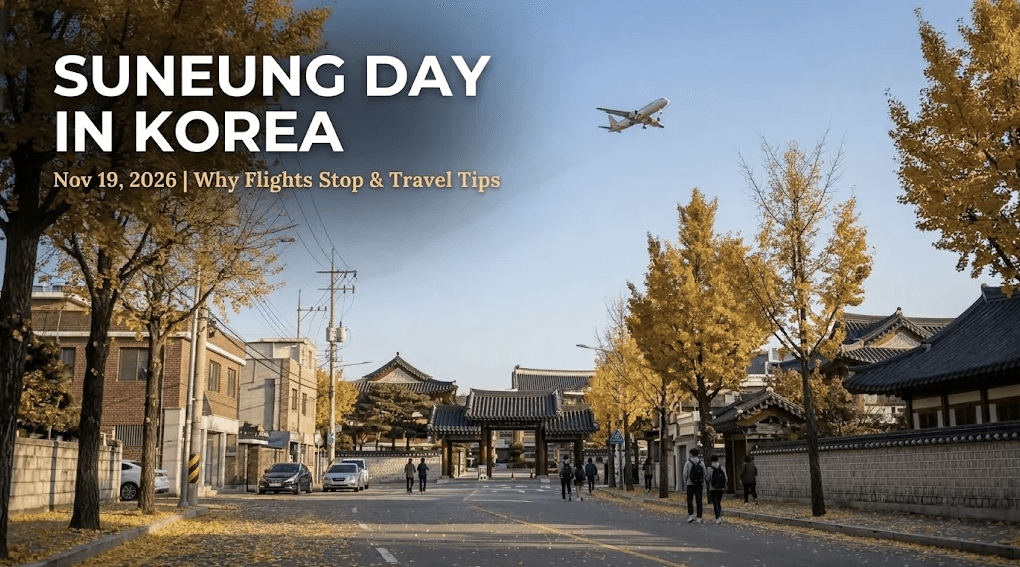
Step outside a subway station in Seoul around 7:30 AM on the third Thursday of November, and the morning commute feels like a scene from an action movie. Neon-yellow police motorcycles idle at major intersections with their engines warm, parents stand outside school gates holding thermoses of hot tea, and not a single car horn dares to honk within two blocks of a high school.
Welcome to Suneung (suneung / 수능)—South Korea’s national College Scholastic Ability Test (CSAT), taking place on Thursday, November 19, 2026.
If you have already checked our Korea’s Q4 Public Holidays (Oct–Dec) Guide, you know that November has zero official “Red Days” on the calendar. Yet on November 19, the entire country temporarily rewrites its timetable around a single nine-hour examination.
Whether you are landing at Incheon International Airport, heading out for morning sightseeing, or exchanging currency at a local bank, here is how Suneung Day works and how to navigate it like a local.
What Is Suneung (CSAT) and Why Does All of Korea Pause?
Officially known as the Daehak Suhak Neungnyeok Siheom (대학수학능력시험)—and labeled the 2027 academic year CSAT because scores determine university entry for the following spring semester—Suneung is the culmination of twelve years of schooling in South Korea.
For the November 19, 2026 exam, the Korea Institute for Curriculum and Evaluation (KICE) and the Ministry of Education have registered 551,864 test-takers across 1,312 test centers in 85 districts nationwide. Remarkably, roughly a third of those candidates—196,473 people—are high school graduates and retakers (jaesusaeng) taking another shot at their dream university, marking the largest retake cohort since 2004.
International headlines love to claim that “South Korea shuts down for Suneung,” but living and working in Seoul tells a much more interesting story. Korea does not close for the day; instead, ministries, subways, airlines, banks, and the military synchronize their clocks so that more than half a million students can reach their desks on time and take the test under completely equal, distraction-free conditions.
Suneung Day 2026 at a Glance: Hour-by-Hour Traveler Timeline
If you are traveling through Seoul, Busan, Jeju, or regional cities on Thursday, November 19, 2026, keep this schedule handy so you never get caught off guard:
| Time Window (KST) | What Happens Nationwide | Practical Impact on Foreign Travelers |
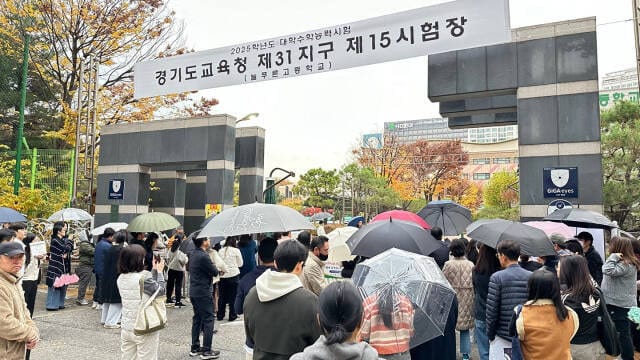
| Wed, Nov 18 (Afternoon) | Preliminary call (ye-bi so-jip / 예비소집) at 1,312 test schools | Expect brief student crowds outside local middle and high schools as candidates pick up exam slips. |
| 06:00 AM – 10:00 AM | Extended morning subway rush hour with extra trains added from 06:00 to 08:10 AM | Subways run more frequently, but road traffic shifts later because office workers commute closer to 10:00 AM. |
| By 08:10 AM | Strict entry cutoff for all 551,864 candidates; 200-meter vehicle ban around test schools | Taxis and buses cannot enter within 200 meters of designated high schools; police cars wait on standby at stations. |
| 08:40 AM – 05:45 PM | Five-period national exam across Korean, Math, English, History/Inquiry, and 2nd Foreign Language | Neighborhoods near schools stay hushed all day; for severely visually impaired test-takers, testing runs until 09:48 PM. |
| 10:00 AM | Government offices, commercial banks, and the stock market (KOSPI, KOSDAQ, KONEX) open 1 hour late | Do not visit a bank branch or district office at 09:00 AM; banks operate 10:00 AM – 05:00 PM instead of 09:00 AM – 04:00 PM. |
| 01:05 PM – 01:40 PM | Nationwide flight takeoff/landing pause for the 01:10 PM – 01:35 PM English listening test | Midday international and domestic flights at Incheon, Gimpo, Jeju, and Gimhae may shift departure or arrival times by 20–40 minutes. |
| 05:45 PM – 09:00 PM | Standard exam ends at 05:45 PM; extra city buses run from 06:00 PM to 09:00 PM | Expect festive, packed streets in Hongdae, Gangnam, Myeongdong, and Seongsu as half a million students celebrate freedom. |
Real-Time Travel Impacts: Flight Groundings, Subway Rush Hours & Bank Delays
1. The 35 Minutes When the Sky Goes Completely Quiet (1:05 PM – 1:40 PM)
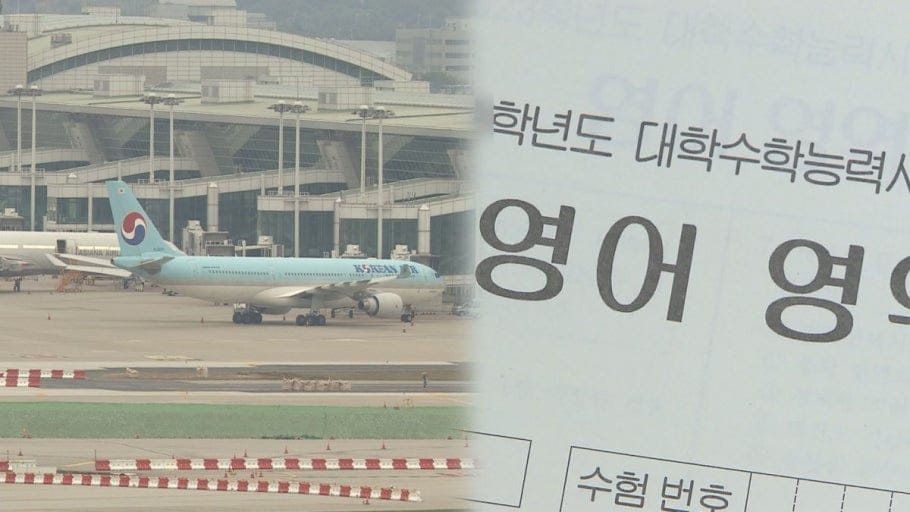
The most famous moment of Suneung Day happens right after lunch. Period 3—the English section—runs from 1:10 PM to 2:20 PM, and its opening 25 minutes (1:10 PM to 1:35 PM) consist of an audio listening test broadcast simultaneously over classroom speakers at all 1,312 test sites.
Because a single roaring jet engine could drown out a question and cost students precious points, aviation authorities enforce a nationwide quiet-sky window from 1:05 PM to 1:40 PM:
- No takeoffs or landings: Every commercial flight across South Korea—except emergency or medical aircraft—is barred from taking off or touching down during this window.
- High-altitude holding patterns: Aircraft already in the sky must maintain an altitude above 3,000 meters (roughly 10,000 feet) to keep ground noise at zero.
- Ground-level silence: Even the Korean military pauses live-fire artillery drills and tank movements, while city buses and trains passing near schools slow down and stay off their horns.
Editor’s Real-Life Tip: If you are flying into or out of Incheon Airport (ICN), Gimpo (GMP), or Jeju (CJU) between 12:30 PM and 2:30 PM on November 19, check your airline app the morning of your flight. Airlines typically re-time midday departures in advance, and once you land, you can hop straight onto the train using our Incheon Airport to Seoul Station AREX & Subway Guide.
2. Morning Subways, Police Escorts, and the 200-Meter No-Car Zone
If you plan to take a morning day trip or move luggage across town on November 19, timing is everything:
- Before 8:10 AM is for test-takers: Students must be seated inside their exam rooms by 8:10 AM sharp—once the school gates lock, latecomers are turned away for an entire year. If a student accidentally goes to the wrong school or gets stuck in traffic, dialing 112 summons a police patrol car or motorcycle to whisk them to the gate with sirens flashing.
- 8:30 AM to 9:45 AM is the “Second Rush Hour”: Because the government asks public offices, banks, and major corporations to push their start time from 9:00 AM to 10:00 AM, Seoul’s morning office rush hour simply slides back by an hour.
- The 200-meter school perimeter: Taxis and private cars are strictly blocked from entering within 200 meters of any test-site middle or high school. If your hotel or guesthouse sits next to a high school, walk a block or two away before hailing a Kakao T taxi in the morning.
3. Banks, Currency Exchange, and Financial Markets Open at 10:00 AM
While cafes, palaces, shopping malls, and restaurants open at their normal hours on Suneung Day, financial and administrative services shift by sixty minutes:
- Commercial bank branches: Across Korea, banks operate from 10:00 AM to 5:00 PM on November 19 instead of their standard 9:00 AM to 4:00 PM window, though airport currency booths, ATMs, and mobile banking apps work without interruption.
- District and immigration offices: Public administrative offices open at 10:00 AM, so confirm any morning visa or administrative appointment in advance.
- Korean stock and foreign exchange markets: The Korea Exchange shifts regular trading on the KOSPI, KOSDAQ, and KONEX boards by one hour to 10:00 AM – 4:30 PM, while the foreign exchange market opens at 10:00 AM.
Sticky Taffy, Seaweed Soup Taboos & Temple Prayers: Cultural Traditions to Spot
Walking around Seoul in the week leading up to November 19 is a cultural treasure hunt if you know what you are looking at. Bakeries, convenience stores, and department store food halls stack their shelves with quirky gift boxes built entirely around Korean wordplay:
- Sticky Sweets for “Sticking” to Your University: In Korean, the verb but-da (붙다) means both “to stick to a surface” and “to pass an exam”. Because of this pun, friends and relatives gift students chewy Yeot (yeot / 엿, traditional malted barley taffy) and Chapssaltteok (chapssaltteok / 찹쌀떡, sweet glutinous rice cakes stuffed with red bean paste) so they “stick” to their first-choice university.
- Forks and Toilet Paper Rolls: You might also spot gift sets containing a dessert fork—meant to help a student “stab” or pick the right answer on a tough multiple-choice question—or a roll of tissue paper, playing on the verb pul-da (풀다), which means both “to unroll paper” and “to solve an exam problem smoothly”.
- The Absolute Taboo—Never Eat Seaweed Soup (
Miyeokguk): On birthdays, Koreans always eat miyeokguk (미역국, beef and seaweed soup). On Suneung morning, however, seaweed soup is strictly forbidden in exam households because the slick, slippery texture of kelp symbolizes “slipping” (mi-kkeo-reo-ji-da) right off the university admission list.
Where to Witness the Emotion: Jogyesa Temple & Bongeunsa Temple
If you want to witness how deeply Korean families care about their children’s future—without disturbing students at a school gate—take a quiet morning walk to Jogyesa Temple in Jongno or Bongeunsa Temple in Gangnam.
On Suneung Day, Jogyesa Temple holds a special all-day prayer service that mirrors the official exam timetable minute-for-minute from 8:40 AM to 5:45 PM. Hundreds of parents and grandparents bow and chant under colourful lanterns for every single period of the test. (If Korean Buddhist culture fascinates you, check out our step-by-step guide on How to Book a Korean Templestay in 5 Minutes.)
Is the “Suneung Cold Snap” (Suneung Hanpa) Real?
Ask any local about mid-November weather, and they will mention Suneung Hanpa (suneung hanpa / 수능 한파)—the folk belief that temperatures plunge below freezing on exam morning every year.
Interestingly, meteorological records tell a calmer story: between 1993 and 2020, Seoul’s morning low dropped below the November average on 15 exam days, and only about 30% of all exam days actually fell below freezing. Still, mid-November mornings are crisp enough that you will want a warm coat—and perhaps a piping-hot pastry from a subway-exit cart using our Traveler’s Guide to Bungeoppang.
After 5:45 PM: When Half a Million Students Hit the Streets
At 5:45 PM, the fifth and final bell rings across South Korea, and twelve months of intense pressure evaporate all at once.
While extra city buses operate from 6:00 PM to 9:00 PM to help students get home, thousands of high school seniors head straight out with friends and family to celebrate. Here is what to expect from Thursday evening through the weekend:
- Packed dining and youth districts: Neighborhoods like Hongdae, Sinchon, Gangnam, Myeongdong, and Seongsu—as well as regional hubs like Seomyeon in Busan or Dongseongno in Daegu—fill up fast after 6:00 PM. If you want Korean BBQ or fried chicken on Thursday night, eat an early dinner around 5:00 PM or book a table in advance.
- The “Suheompyo” (Exam Slip) Discount Wave: Starting on the evening of November 19 and running through December, theme parks (like Lotte World and Everland), movie theaters, electronics stores, hair salons, and restaurants roll out massive “Suneung Discounts” for students carrying their physical exam identification slip (suheompyo). Because theme parks will be packed with celebrating high schoolers on Friday, November 20 and over the weekend, foreign travelers are much better off visiting palaces, museums, or autumn parks instead.
💬 Frequently Asked Questions (FAQ)
Q: Is Suneung Day (November 19, 2026) a public holiday in South Korea?
A: No. Suneung Day is a regular working Thursday, not a national public holiday. Tourist attractions, palaces, restaurants, cafes, shopping malls, and public transit operate all day—only morning commuting hours, bank/stock market opening times (shifted to 10:00 AM), and midday flights (1:05 PM – 1:40 PM) are adjusted.
Q: Will my flight to or from Korea be canceled on November 19, 2026?
A: Flights are not canceled for the day, but all takeoffs and landings across Korean airports are paused during the 1:05 PM – 1:40 PM quiet window for the 1:10 PM – 1:35 PM English listening test. If your flight is scheduled around midday, airlines usually adjust the departure or arrival time by 20 to 40 minutes; check your airline’s mobile app a day before travel.
Q: What is the best time for tourists to use the Seoul subway on Suneung morning?
A: Aim to board the subway after 10:00 AM if you want a relaxed ride, especially if you are carrying suitcases. Between 6:00 AM and 8:10 AM, subways carry half a million nervous students (with extra trains running), and between 8:30 AM and 10:00 AM, trains fill with office workers whose commute was delayed by an hour.
Q: Can I buy Yeot taffy or Chapssaltteok rice cakes as a souvenir in mid-November?
A: Absolutely! During the first three weeks of November, bakeries like Paris Baguette and Tous Les Jours, traditional markets like Gwangjang Market, and convenience stores (CU, GS25, 7-Eleven) sell festive Suneung gift boxes packed with chapssaltteok (glutinous rice cakes), yeot (Korean taffy), and chocolates. They make a delicious, culturally meaningful autumn treat to try during your trip.