
For years, the ultimate South Korea tourist checklist looked pretty much the same: stuff a basket full of sheet masks at Olive Young in Myeongdong, then head straight to a Gangnam dermatology clinic for lasers or Botox. That was the undisputed gold standard of a K-Beauty trip.
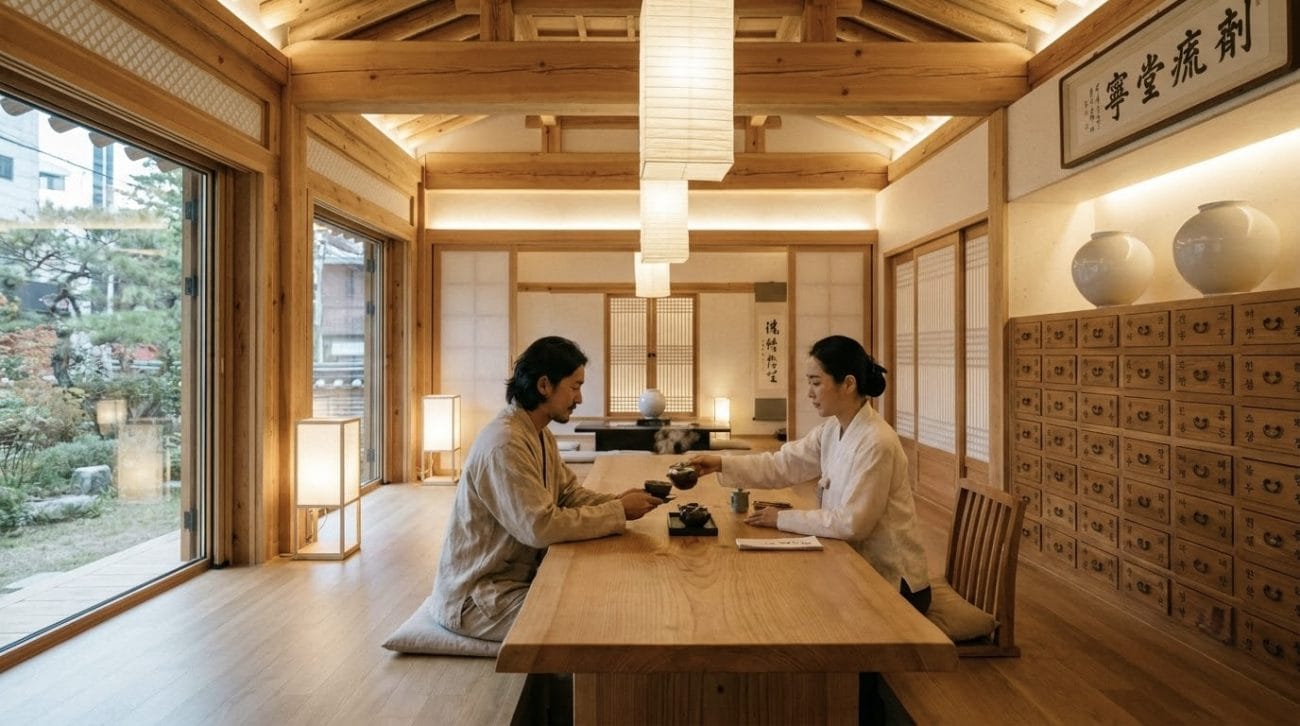
Walk around Seoul’s main neighborhoods today, though, and you’ll notice a shift. Waiting rooms at traditional Korean medicine clinics—known locally as Haniwon (한의원)—are now just as packed with international travelers as the famous skin clinics down the street.
At first glance, it sounds a little intimidating. The earthy smell of boiled herbs hits you the second you open the door, and nobody exactly dreams of getting poked with needles on vacation. Yet scroll through TikTok or Reddit travel threads, and people are raving about it. Here is a breakdown of what actually happens inside a Korean medicine clinic, the physiological science behind why it fixes travel fatigue so fast, and how much you’ll pay without Korean national health insurance.
1. From Michael Phelps to BTS: The Story Behind the “Purple Stamps”
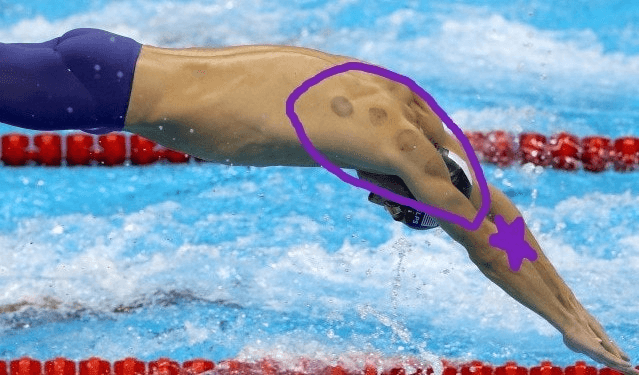
For many Westerners, cupping first entered the mainstream radar through the Olympics and Hollywood. Everyone remembers swimmer Michael Phelps stepping onto the pool deck covered in dark purple circles on his way to winning gold. Soon after, celebrities like Justin Bieber, Gwyneth Paltrow, and Kim Kardashian were showing off their own cupping marks on red carpets and Instagram, turning an ancient therapy into a go-to modern recovery tool.
Then K-Pop poured fuel on the fire. Fans watching behind-the-scenes tour documentaries noticed members of BTS and BLACKPINK getting acupuncture between rehearsals or taking traditional herbal tonics like Gongjindan to survive brutal world tour schedules. Naturally, fans flying into Seoul wanted to try the exact recovery methods keeping their favorite idols on their feet.
Still, celebrity hype only gets people in the door once. The reason travelers keep coming back comes down to pure physical relief. Sitting cramped in an economy seat for 12 hours wrecks your lower back and wreaks havoc on your sleep cycle. Korean medicine tackles jet lag and muscle stiffness without relying on heavy painkillers, which aligns with the growing global shift toward natural, holistic recovery.
2. 4 Treatments Travelers Actually Get (And the Science Behind Why They Work)
Locals usually pop into a neighborhood clinic when they sprain an ankle or tweak their back, going several times a week. Short-term tourists don’t have that kind of time. Clinics catering to visitors focus on one-off sessions that deliver an immediate, noticeable difference the moment you step off the bed.
2-1. Dry Cupping: Fascia Decompression & Lactic Acid Flush
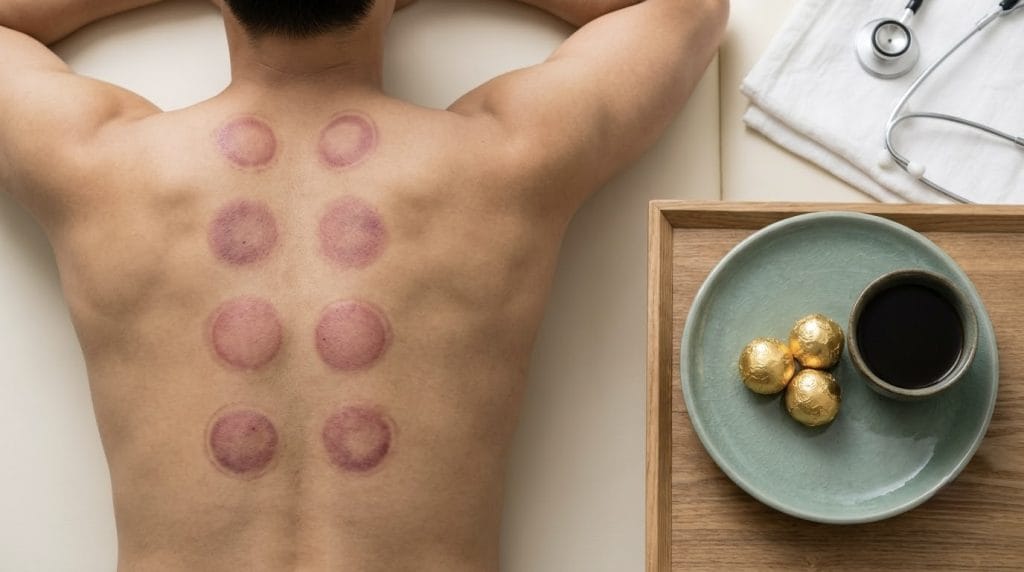
While older Korean patients often prefer “wet cupping” (which involves a tiny prick to draw out stagnant blood), most international clinics stick to dry cupping so you don’t have to deal with blood.
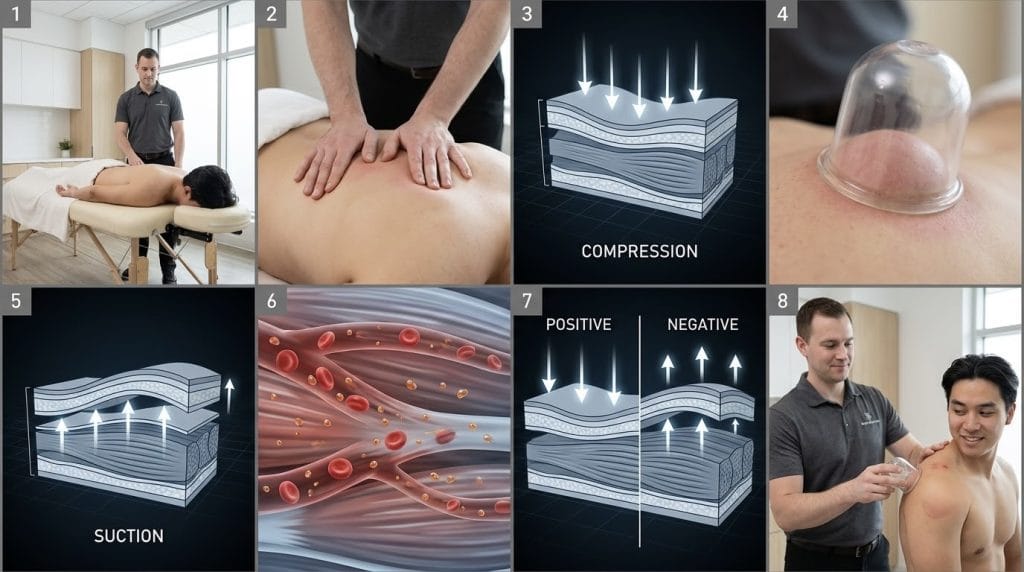
Think of regular massage as pushing down on tight muscles. Cupping does the exact opposite. By creating a vacuum inside the cup, it pulls the skin, fascia, and muscle upward. This negative pressure creates physical space between adhered tissue layers and forces compressed capillaries to dilate. Fresh, oxygen-rich blood rushes in, while lactic acid and metabolic waste get flushed out through the lymphatic system.
Those dark red or purple circles left behind aren’t bruises from blunt trauma. They happen when fragile, stagnant micro-capillaries rupture under suction and rise toward the surface. Your immune system reads those spots as a mild injury, sending macrophages and growth factors to repair the tissue faster than it would on its own.
2-2. Acupuncture: Resetting Your Nervous System
Acupuncture works by triggering a controlled micro-response in your nervous system. When a practitioner inserts a hair-thin needle directly into a muscle knot (a myofascial trigger point), the muscle often gives a tiny twitch and then releases its grip. Your brain registers the needle as a micro-intrusion, immediately boosting local blood flow and releasing endorphins—your body’s built-in painkillers—along with anti-inflammatory compounds.
Even better for travelers is what happens to your autonomic nervous system. Jet lag and travel insomnia happen because your sympathetic nervous system (your “fight-or-flight” mode) is stuck in overdrive. Stimulating specific meridian points dials down that stress response and flips on the parasympathetic nervous system (“rest-and-digest”). That’s why almost everyone ends up falling into a dead sleep during their 20-minute needle retention time, even if they were nervous walking in.
2-3. Chuna Manual Therapy: Realigning Joints After 20,000 Steps
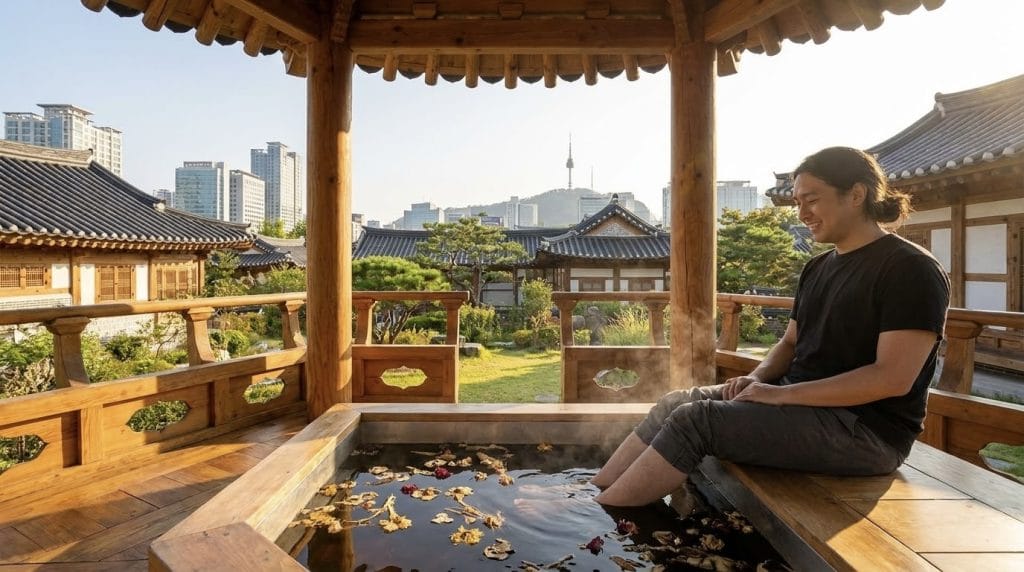
A trip to Seoul is an accidental workout. Between hauling luggage up endless subway stairs—many without escalators—and clocking 20,000 steps a day on concrete, your pelvis and lower back take a beating by day three.
Chuna is Korean hands-on spinal and joint manipulation performed directly by a licensed doctor. Unlike aggressive bone-cracking, Chuna blends targeted joint mobilization with deep soft-tissue stretching. It physically opens up compressed spaces between vertebrae, takes pressure off pinched nerves, and restores range of motion to tight hip flexors and calves. Walking out of the clinic, your stride feels noticeably lighter.
2-4. Cosmetic Acupuncture (Jeongan-chim): Natural Lifting & Collagen Production
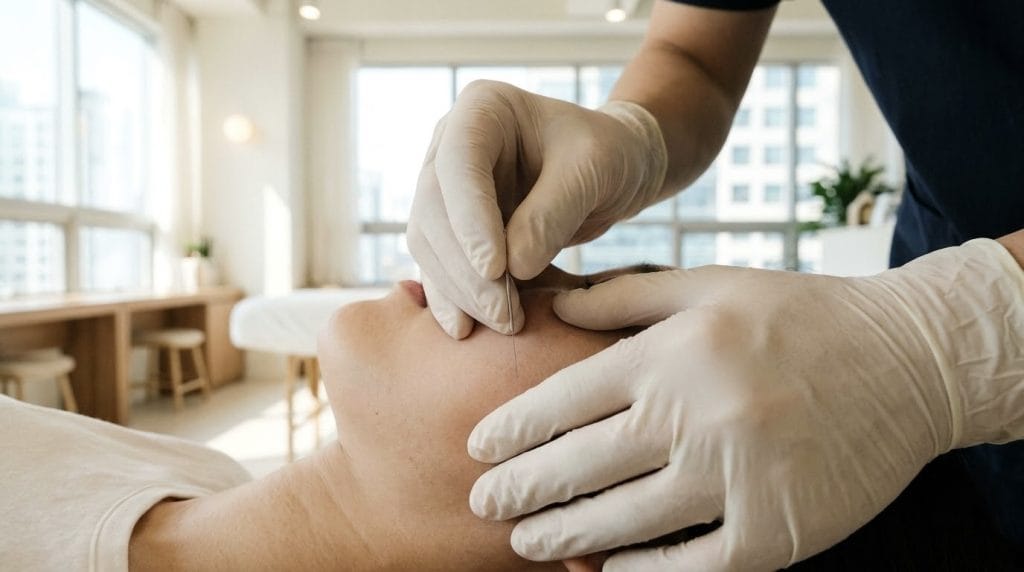
If Botox freezes muscles and fillers add artificial volume, cosmetic acupuncture wakes up your face’s own structural support. Dozens of tiny muscles control your facial expressions; over time, the ones you clench (like your jaw) bulk up, while underused muscles sag, creating asymmetry and deep lines.
By placing ultra-fine needles along the jawline, temples, and cheeks, the doctor releases chronic tension—instantly softening a square jaw or uneven smile. At the same time, the needle tips create microscopic channels in the dermis and the deeper SMAS fascia layer. As your skin heals those tiny micro-channels, it ramps up natural collagen and elastin production. Plus, the boost in lymphatic drainage clears out the morning facial puffiness caused by late-night Korean BBQ and salty street food.
| Treatment | Core Physiological Mechanism | Best For (Traveler Profile) |
| Dry Cupping | Negative-pressure fascia decompression, blood flow boost, lactic acid flush | Rock-hard shoulders, neck stiffness, heavy upper back |
| Acupuncture | Trigger-point release, endorphin surge, parasympathetic nervous system activation | Severe jet lag, insomnia, acute muscle knots |
| Chuna Therapy | Manual joint realignment, spinal decompression, ligament stretching | Lower back pain and sore legs from long flights & walking 20k+ steps |
| Cosmetic Acupuncture | Facial muscle relaxation, dermal micro-stimulation for collagen & lymph drainage | Natural facial lifting, de-puffing, jaw tension relief without Botox |
3. Real Costs Without Korean Insurance & How to Claim Travel Insurance
Because short-term visitors aren’t covered by Korea’s National Health Insurance (NHI), you will pay the 100% non-insured rate (called Bi-geub-yeo). The good news is that medical care in Korea is still remarkably affordable compared to the US, Europe, or Australia.
- Local Neighborhood Clinics (Basic Care): Consultation + Acupuncture + Cupping + Physical Therapy (heat/electro-stimulation) runs about ₩30,000 to ₩70,000 ($22–$52 USD). Note: English may be very limited.
- Foreigner-Friendly Specialized Clinics (Gangnam, Myeongdong, Hongdae): Includes dedicated in-house English interpreters, private treatment rooms, Chuna therapy, cosmetic acupuncture, or herbal pouches. Expect to pay ₩100,000 to ₩250,000+ ($75–$190+ USD) per session depending on the package.
- Budget Public Cultural Experience (Seoul K-Medi Center in Dongdaemun): Located inside Gyeongdong Market, you can enjoy a rooftop herbal foot bath and basic wellness experience for around ₩10,000 ($7.50 USD).
💡 Money-Saving Tip: Use Your Travel Insurance! Before booking a private clinic, check their website or Instagram to make sure they post transparent, fixed pricing for international patients. More importantly, if you come in for actual pain (like a stiff neck from the flight or a twisted ankle on the stairs), ask the front desk for an Itemized Receipt and Medical Certificate in English matching your passport name. Many comprehensive travel insurance policies reimburse acupuncture and manual therapy when billed as acute pain treatment rather than a spa visit.
💬 Frequently Asked Questions (FAQ)
Q1. Do acupuncture needles hurt like hospital syringes? Is it hygienic?
A. Not at all. Medical syringes are thick and hollow because they have to inject liquid through the tip. Acupuncture needles are solid, rounded at the microscopic tip, and only 0.2mm to 0.3mm wide—roughly the thickness of a human hair. You might feel a tiny mosquito-like pinch as it passes the skin. Once it hits a deep muscle knot, you’ll feel a heavy, dull ache or slight tingle (known as Deqi). That dull ache is actually the sign that the muscle receptor is releasing. As for hygiene, every clinic in South Korea is strictly regulated by the Ministry of Health and Welfare and uses 100% single-use, pre-sterilized disposable needles that are thrown into biohazard bins immediately after your session.
Q2. I have severe needle phobia. Can I still visit a clinic?
A. Yes! Just let the coordinator or doctor know during your consultation that you want a needle-free session. They can easily build a recovery course around dry cupping, moxibustion (warming meridian points using aromatic mugwort heat to boost deep circulation), Chuna stretching, and machine-based pulse and body-constitution analysis (Sasang typology).
Q3. How long do the round cupping marks stay on my back?
A. Depending on your skin sensitivity and how much stagnation you had in the muscle, the marks fade completely within 1 to 2 weeks. Interestingly, while many locals cover them up in the summer, international travelers often treat them as a badge of honor—snapping photos in tank tops for Instagram as proof they got an authentic Korean recovery session.
Q4. Can I just walk in without an appointment if I don’t speak Korean?
A. While local neighborhood clinics accept walk-ins all day, describing subtle nerve pain or medical history through a translation app can be frustrating for both sides. If you don’t speak Korean, book ahead at a certified foreigner-friendly clinic in areas like Gangnam, Myeongdong, or Hongdae via WhatsApp, Instagram DM, or platforms like Klook and Creatrip. Having an English coordinator walk you through the intake form and insurance paperwork makes the whole experience stress-free.