

When a friend visiting from California told me she was flying to South Korea mainly to get her eyes lasered, I thought she was joking. Flying across the Pacific for eye surgery sounded extreme.
Then she showed me the quote from her local clinic back in Los Angeles: $5,600 USD for both eyes.
Two days after landing at Incheon Airport, she walked into a multi-floor clinic near Gangnam Station, went through two hours of testing, and had the exact same procedure done on the latest Carl Zeiss machine for 2.4 million KRW (roughly $1,800 USD). Even after adding her hotel and a week of Korean BBQ, she still came out thousands of dollars ahead.
If you are researching SMILE LASIK in Seoul, you have probably seen the polished clinic websites and the TikTok videos making it look like a quick spa trip. In reality, it is still a medical procedure in a foreign country—and the experience can feel overwhelming if you do not know what to expect.
Here is an honest, no-fluff breakdown of what SMILE LASIK actually costs in Korea, how the famous “factory clinics” operate, what the recovery really feels like, and whether it makes sense for your trip.
How Much Does SMILE LASIK Actually Cost in Korea? (2026 Breakdown)
In the US, Canada, Australia, and much of Europe, laser vision correction is priced as a luxury elective procedure. In South Korea, the sheer volume of patients—combined with fierce competition among hundreds of clinics packed into Seoul’s Gangnam and Apgujeong districts—keeps prices remarkably low.
However, the base surgery price you see advertised on Instagram is not the final number you will pay on surgery day. You need to budget for a few add-ons and pharmacy costs.
| Cost Category | Standard SMILE (VisuMax 500) | SMILE Pro (VisuMax 800) | Notes & What to Expect |
| Base Surgery (Both Eyes) | 2,100,000 – 2,800,000 KRW (~$1,550 – $2,100 USD) | 3,500,000 – 4,300,000 KRW (~$2,600 – $3,200 USD) | Often discounted by 100k–200k KRW if you do same-day exam + surgery. |
| Pre-Op Eye Exam | Free – 50,000 KRW | Free – 50,000 KRW | Almost always waived if you proceed with surgery at that clinic. |
| Corneal Cross-Linking (Optional) | 300,000 – 500,000 KRW | 300,000 – 500,000 KRW | Recommended if your corneas are on the thinner side for extra stability. |
| Autologous Serum Drops (Optional) | 100,000 – 150,000 KRW | 100,000 – 150,000 KRW | Made from a quick blood draw on-site; helps speed up surface healing. |
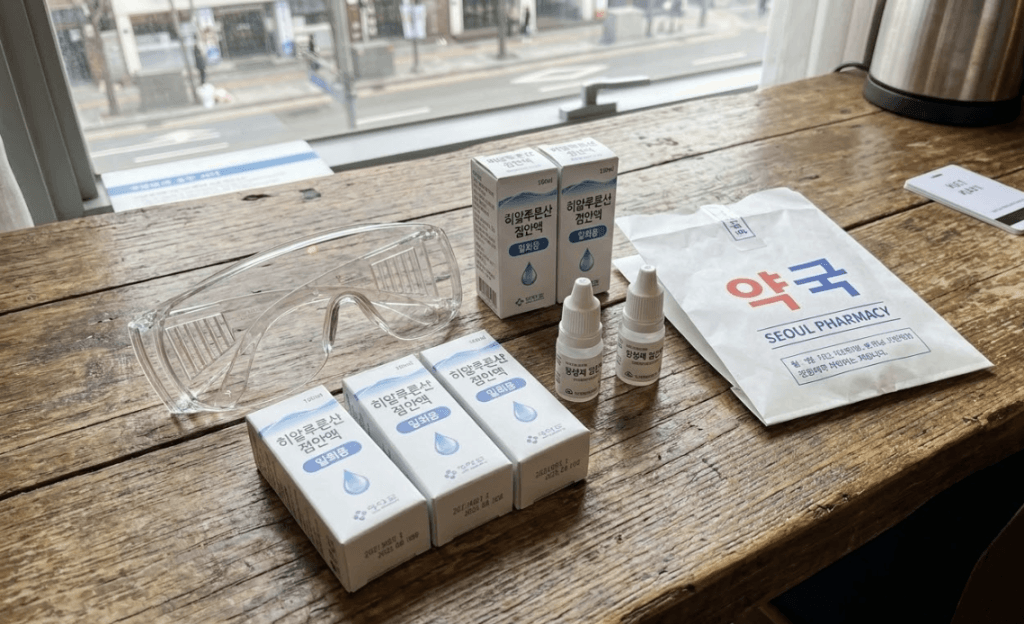
| Post-Op Pharmacy Prescription | 50,000 – 90,000 KRW | 50,000 – 90,000 KRW | Paid separately at the downstairs pharmacy (antibiotics, steroids, 3–4 boxes of artificial tears). |
| English Medical Certificate | Free – 30,000 KRW | Free – 30,000 KRW | Request this if you plan to submit a claim to your home insurance or HSA/FSA. |
The bottom line on cost: Expect to swipe your card for around 2.5 million to 2.9 million KRW total for standard SMILE, or around 3.8 million to 4.2 million KRW if you upgrade to SMILE Pro.
Quick payment tip: Always ask the clinic receptionist to charge your credit card in KRW (Korean Won) rather than your home currency. Dynamic Currency Conversion (DCC) at medical terminals can quietly tack on an extra 4% to 6% in terrible exchange rates.
SMILE vs. SMILE Pro: Is the 1.5 Million KRW Upgrade Worth It?
Once you finish your eye exam in Seoul, the consultant will almost certainly ask you to choose between Standard SMILE and SMILE Pro.
Both procedures work on the exact same principle: instead of creating a large flap on the surface of your eye (like traditional LASIK) or scraping off the top layer (like LASEK/PRK), the laser creates a microscopic lens-shaped piece of tissue (a lenticule) inside your cornea and removes it through a tiny 2mm keyhole incision.
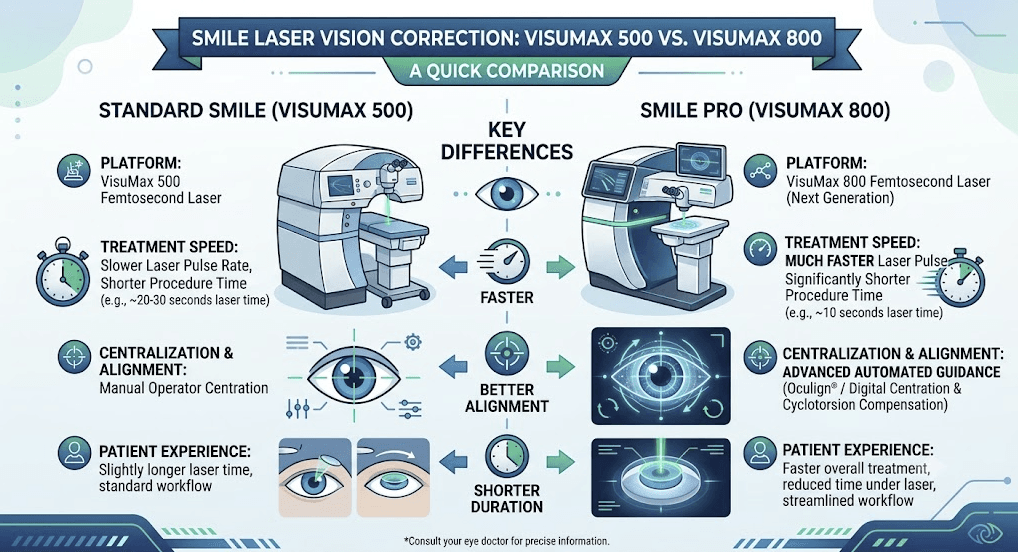
The difference comes down to the machine generation:
- Standard SMILE (VisuMax 500): The laser takes about 22 to 25 seconds per eye to create the lenticule. It has a decade-long track record in Korea with millions of successful cases.
- SMILE Pro (VisuMax 800): The newer machine cuts the laser time down to under 10 seconds per eye. It also includes an automated centration and astigmatism-tracking guide (OcuLign), which helps if you have high astigmatism or large pupils.
Who should upgrade? Honestly, if you have mild-to-moderate nearsightedness and low astigmatism, standard SMILE delivers the exact same final vision for $1,000 less. However, if you have high astigmatism, get severe anxiety about keeping your eye still during the suction phase, or simply want the fastest possible laser time, SMILE Pro takes a lot of mental pressure off during the procedure.
“Factory-Style” vs. Boutique Clinics in Gangnam: The Honest Truth
If you walk out of Exit 10 or 11 at Gangnam Station, you are standing in the highest concentration of eye surgery clinics on the planet. Foreigners usually end up choosing between two very different clinic styles.
1. The Mega “Factory” Clinics
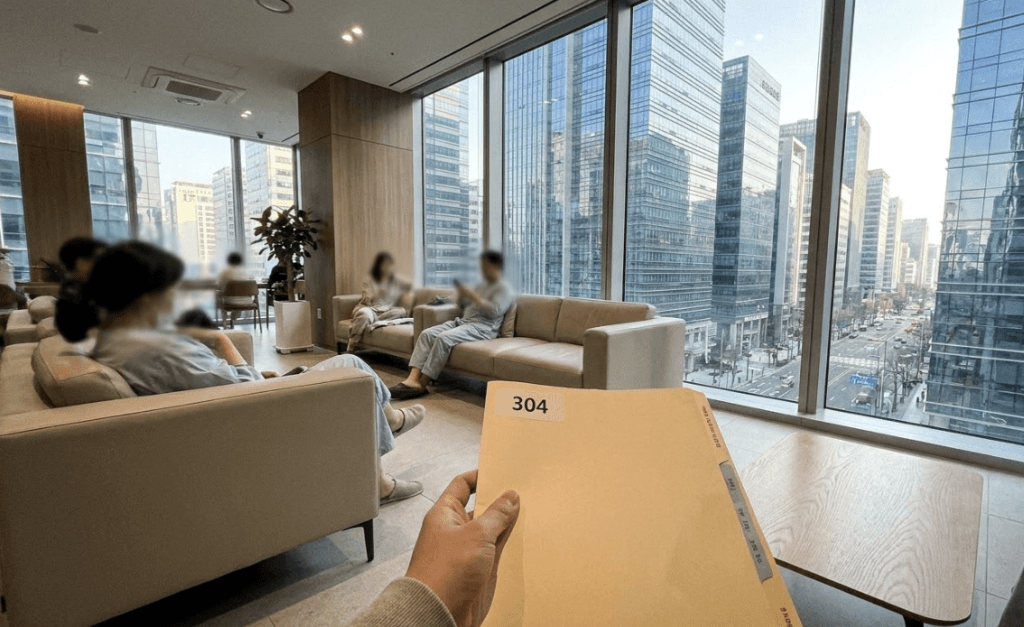
When you walk into a major Gangnam eye center, it looks less like a doctor’s office and more like an airport business lounge. These clinics occupy three or four floors of a skyscraper, employ 10 to 15 surgeons, and run dozens of diagnostic machines simultaneously.
- The Good: They have dedicated in-house English translators who walk with you from station to station. Because they do thousands of surgeries a month, their equipment is brand new, their prices are aggressive, and they can easily handle a 1-Day Exam + Surgery schedule.
- The Downside (What Nobody Mentions): It feels like a high-efficiency conveyor belt. If you book a Friday afternoon or Saturday morning slot, the waiting area is packed. You will carry a numbered folder from chair to chair for 90 minutes, and you might only speak with your actual operating surgeon for three minutes right before walking into the laser room.
2. Small Boutique Clinics (1–2 Surgeons)
These are quieter practices run by one or two veteran ophthalmologists.
- The Good: The surgeon personally reviews your corneal topography with you, the waiting room is calm, and you never feel rushed into an upsell.
- The Downside: Many smaller clinics do not have full-time English staff on duty every day, so you may need to bring a Korean-speaking friend or book specific translation hours in advance.
What the 1-Day Surgery Timeline Actually Feels Like
Most tourists book the “1-Day Package”—meaning your comprehensive exam happens in the morning and your surgery takes place that same afternoon. Here is what that day actually looks like in practice:
- Before You Even Fly to Korea: You must stop wearing soft contact lenses for at least 7 full days prior to your exam (14 days for toric lenses for astigmatism, and up to 3 weeks for hard RGP lenses). Contacts warp the natural shape of your cornea, and clinics will turn you away if your measurements aren’t stable.
- 9:30 AM – The 90-Minute Testing Marathon: Your English coordinator meets you at reception. For the next hour and a half, you will move through 12 to 15 different machines. Expect the classic air-puff test, corneal thickness mapping, retinal photography, tear film checks, and a DNA swab (inside your cheek) to rule out rare genetic corneal dystrophies.
- 11:00 AM – Consultation & Decision: You meet with a consultant (and then the doctor) to review your numbers. If your corneas are thick enough and healthy, you pick your surgery tier. If your corneas are too thin for SMILE, they will be blunt with you and suggest LASEK or ICL instead.
- 2:00 PM – The 15-Minute Surgery: You change into a surgical gown, get numbing drops, and lie down under the VisuMax laser. The doctor places an eyelid holder (no, you cannot blink by accident). You stare at a blinking green dot. For about 10 to 25 seconds, your vision fades to white/gray while the laser works—it is completely painless, just a slight pressure sensation. Then the surgeon gently slides the tissue out. Fifteen minutes after walking in, you are walking out.
- 3:00 PM to 7:00 PM – The “Cutting Onions” Phase: Here is the part glossy brochures gloss over. Once the numbing drops wear off about 30 minutes later—usually right when you are in the taxi back to your hotel—your eyes will burn, water uncontrollably, and feel extremely sensitive to light. Do not try to take the subway back. Keep your eyes closed, put in your prescribed drops on schedule, listen to an audiobook, and take a 4-hour nap.
- 8:00 PM – The Clear Vision Moment: By evening, the burning stops almost completely. Your vision will still look slightly hazy—like looking through a steamy bathroom mirror—but you can already read the TV across the hotel room without glasses.
- Next Morning (10:00 AM): You return to the clinic for a 5-minute slit-lamp checkup. Most patients test at 80% to 90% vision the very next morning and are cleared to fly home and resume normal sightseeing.
How to Fit SMILE LASIK Into a 5-Day Seoul Itinerary
One of the biggest mistakes travelers make is scheduling outdoor palace tours or heavy shopping right after surgery, or booking surgery on their final day before a 12-hour dry airplane flight.
If you have 5 days in Seoul, structure your trip like this:
| Day | Morning Plan | Afternoon / Evening Plan | Why This Works Best |
| Day 1 | Arrive in Seoul, check into hotel | Gyeongbokgung Palace, Bukchon Hanok Village, Myeongdong street food | Enjoy dusty outdoor sights and smoky K-BBQ before your eyes are operated on. |
| Day 2 (Surgery Day) | 9:30 AM: Pre-op exam at Gangnam clinic | 2:00 PM: SMILE Surgery → Taxi straight to hotel for a 5-hour sleep + room service | Gives you a full afternoon and night to rest your eyes in a dark room. |
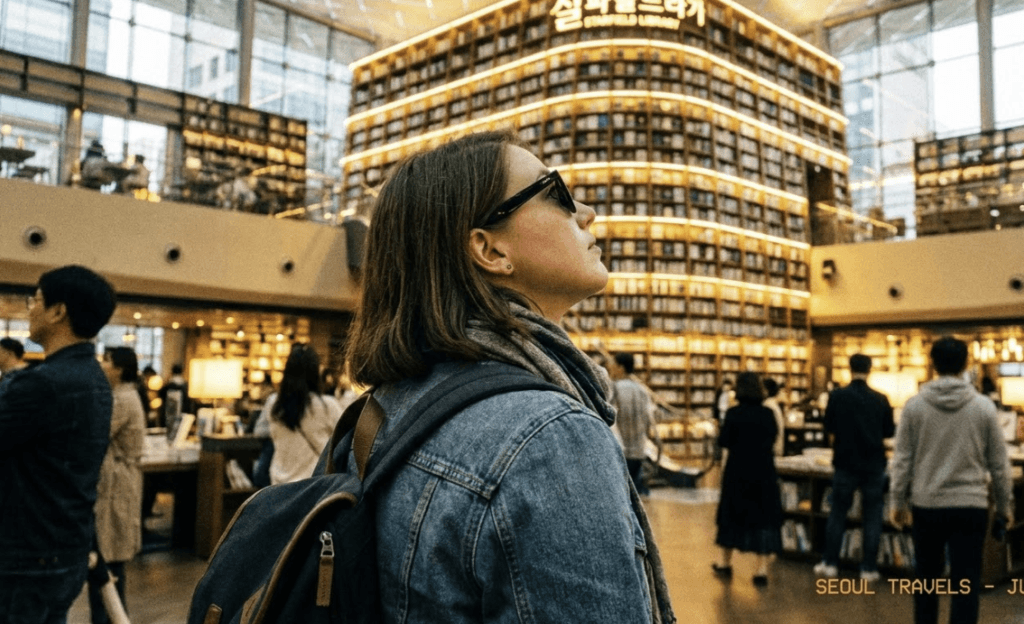
| Day 3 | 10:00 AM: 10-minute post-op checkup in Gangnam | COEX Mall (Starfield Library), indoor cafes in Seongsu-dong, Han River night walk | Keeps you out of harsh midday UV light while letting you enjoy Seoul right away. |
| Day 4 | Hongdae / Yeonnam-dong shopping & Olive Young | Namsan Tower cable car or river cruise | Vision is sharp; you just need sunglasses outdoors and artificial tears every hour. |
| Day 5 | Pack & head to Incheon Airport | Fly home (keep preservative-free tears in your carry-on!) | Airplane cabins are desert-dry; having 72 hours of healing before flying makes the flight much more comfortable. |
4 Practical Tips Before You Book
- Pre-install Kakao T or Uber Before Walking Into the Clinic: Your pupils may be dilated from the exam, and post-surgery your vision will be too milky and light-sensitive to read small text on your phone screen. Have your hotel address saved in Korean in your ride-hailing app ahead of time.
- Bring High-Quality UV Sunglasses (Without Polarization if Possible): You will need to wear sunglasses outdoors for the first week to protect against UV rays, wind, and dust. Most clinics hand out clear plastic protective goggles for sleeping (so you do not rub your eyes at night), but bring your own dark shades for walking outside.
- Skip the Jjimjilbang (Korean Bathhouse) and Soju: Clinics in Korea are strict about two things post-surgery: no alcohol for at least 7 days (it causes inflammation and severe dryness) and no saunas, swimming pools, or hot steam rooms for 2 to 4 weeks due to infection risk. If a Korean bathhouse is on your bucket list, go before surgery day.
- Stock Up on Artificial Tears Before Leaving Korea: Preservative-free single-use hyaluronic acid eye drops in Korea are high quality, require a simple clinic prescription for the cheap bulk boxes, and cost a fraction of what they cost in Western pharmacies. Ask your doctor to prescribe the maximum number of boxes allowed before you fly out.
Final Verdict: Is It Worth It?
If you live in a country where SMILE LASIK costs $4,500 to $6,000+ USD and you are already planning a trip to East Asia, getting the procedure done in Seoul is a genuine no-brainer. The surgical volume and laser technology in Gangnam are world-class, recovery takes less than 24 hours, and the savings essentially pay for your entire vacation.
Just go in with realistic expectations: treat the clinic visit as an efficient medical errand rather than a luxury spa experience, clear your schedule for the afternoon of surgery day, and let your eyes rest before hitting the streets of Seoul again.
Disclaimer: This article is based on personal research, clinic consultations, and patient experiences in South Korea for informational and travel-planning purposes only. It does not constitute professional medical advice, diagnosis, or treatment. Always consult a qualified ophthalmologist regarding your specific eye health and surgical eligibility.
💬 Frequently Asked Questions (FAQ)
Can I get SMILE LASIK in Seoul if I don’t speak Korean?
Yes. Major clinics in Gangnam assign a dedicated English coordinator who walks with you through all 15 pre-op tests and translates inside the operating room. One caveat: on busy Friday afternoons, translators often juggle multiple foreign patients at once. Book a Tuesday or Wednesday morning slot (9:00 AM) so you don’t feel rushed.
Can I take the subway back to my hotel after 1-Day SMILE surgery?
Do not attempt the subway. For the first 25 minutes after surgery, numbing drops make everything feel fine. Once they wear off, your eyes will water heavily and burn for 3 to 4 hours. Pre-save your hotel address in the Kakao T or Uber app before your appointment and take a taxi straight to bed.
Are there hidden fees beyond the advertised SMILE LASIK price in Korea?
The advertised 2.1M–2.5M KRW price covers only the base laser procedure. You must pay an extra 50,000 to 90,000 KRW at the downstairs pharmacy for antibiotic drops and artificial tears. Optional add-ons like corneal cross-linking (300k–500k KRW) or autologous serum drops (100k–150k KRW) can also raise your final bill.
How soon can I fly home after getting SMILE LASIK in Korea?
Medically, you are cleared to fly right after your next-morning checkup because the 2mm keyhole incision isn’t affected by cabin pressure. Practically speaking, long-haul flights are brutally dry. Give yourself at least 48 to 72 hours in Seoul post-surgery before flying, and use preservative-free tears every hour on the plane.
How long do I need to stop wearing contact lenses before my exam?
Stop wearing regular soft lenses at least 7 full days before your exam in Seoul. If you wear toric lenses for astigmatism, stop 14 days prior; for hard RGP lenses, stop 3 weeks prior. Clinics will refuse same-day surgery if your corneas are still warped from contacts.
What happens if I am disqualified from SMILE LASIK during the exam?
Around 10–15% of patients find out their corneas are too thin for SMILE. Your surgeon will usually offer two alternatives: LASEK (cheaper and safe, but requires 4–5 days of painful recovery and protective contact lens removal before flying) or ICL lens implantation (fast recovery like SMILE, but costs 4.5M–5.8M KRW).